The Geometric Periodic Table
Two interactive 3D views of the 120° structure
The periodic table is not a flat grid—it's a three-dimensional geometric structure where each period occupies 120° of arc, with elements organized radially by d-electron count and group.
Below are two complementary 3D visualizations of the same underlying geometry. Each emphasizes different aspects of the structure.
The Shared Principle: 120° Per Period
Both visualizations are based on the same geometric foundation:
- 120° per period - Three periods complete a full 360° rotation
- Radial organization - Position determined by d-electron count (Groups 4-6: d=2,3,4)
- Angular ranges - s-block (0°-17°), d-block (17°-34°), p-block (34°-60°), noble gases (120°)
- f-block interleaving - Lanthanides and actinides nested within d-block angular range
Choose Your View
3D Vortex (Geometric)
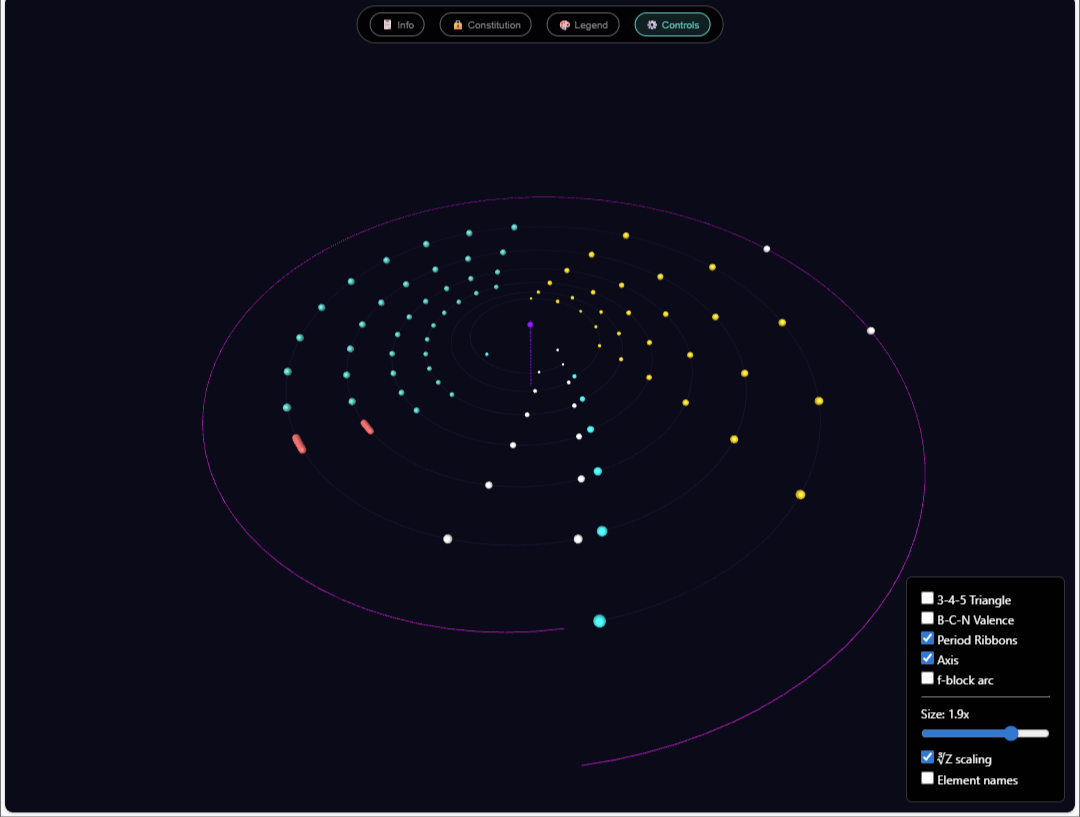
Interactive 3D projection with the 3-4-5 triangle at center. Shows the geometric foundation and makes the 120° structure visible. Rotate, zoom, and explore element properties. Best for understanding the mathematical basis.
Launch Interactive →Period Tower (Coordinates)
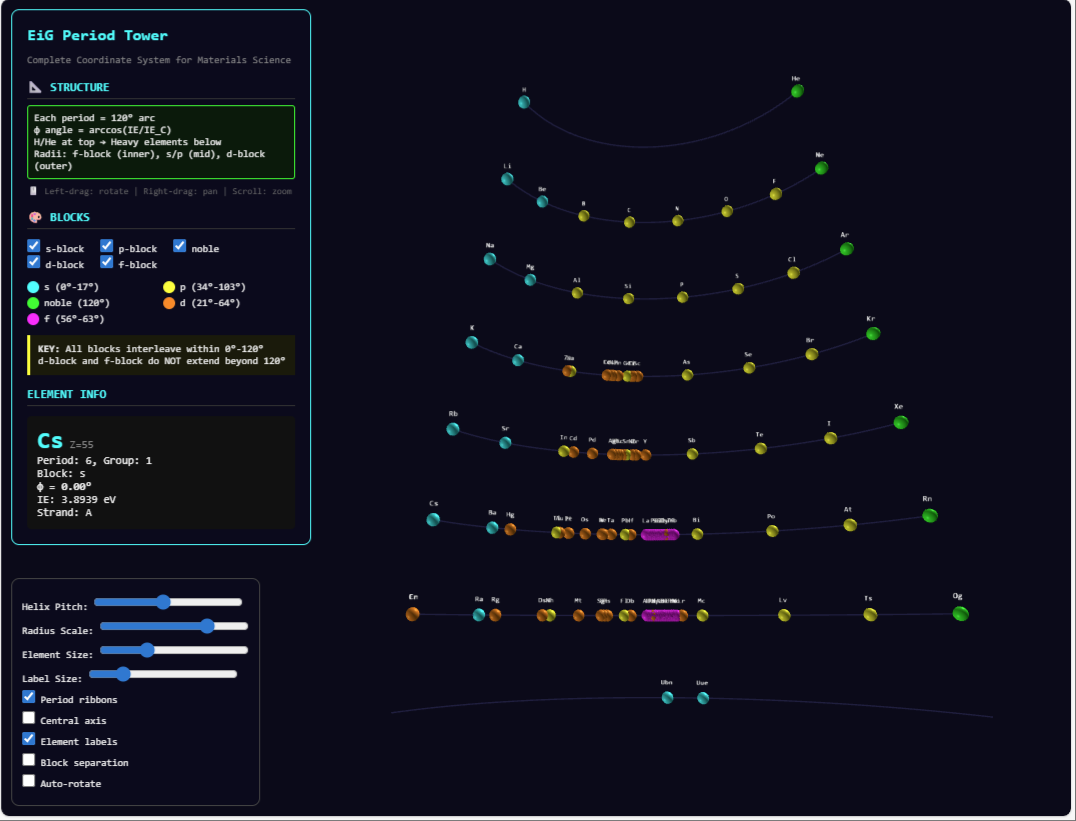
Discrete orbital bands like planets at fixed distances. Emphasizes the constitutional coordinates (d, P, g) used for property predictions. Interactive 3D view with element data on hover. Best for understanding the coordinate system.
Launch Interactive →